By Gen-Arc Nutrition | WADA Compliance · NADA · Anti-Doping · Protein Purity · Athlete Safety
WADA Awareness Should Matter To Every Tested Athlete
To be the best, you might train consistently and take the right protein to boost performance. But even a small, unintentional misstep could hamper all your efforts. The world of sports has been fighting against doping and harmful substances for decades.
Every year, agencies like WADA (World Anti-Doping Agency) review and republish their list of banned substances, such as this year’s 2026 Prohibited List, which was effective from 1 January. However, a 2022 survey of elite Indian athletes found that 40% or fewer had received any anti-doping updates in the recent past. Researchers described the overall awareness of anti-doping rules and agencies among this group as poor (Medical Journal of the Armed Forces India, 2022 — survey of elite Indian athletes).
Why the Responsibility Falls on the Athlete
Article 2.1.1 under the World Anti-Doping Code sets out the principle of strict liability: an athlete is accountable for whatever is found in their body, regardless of intent, regardless of what a label claimed, regardless of whether the source was deliberate or accidental.
So in this day and age, when you search “protein powder for athletes”, the real question you should be asking is: does it contain any prohibited substances that could harm your body, or end your career? That’s exactly what we’ll walk you through in this guide: what typically goes wrong industry-wide, what to check before trusting any label, and where Gen-Arc stands against every one of those checks.
Where the Real Risk Actually Starts
Across the supplement industry, the recurring problems are well documented: mislabeling, undeclared ingredients, inconsistent quality from one production batch to the next, and testing marketing claims without real batch-level proof to back them up. None of this requires bad intent. Cross-contamination can happen on shared manufacturing lines, sourcing can shift between batches, and a claim written once on a product page doesn’t automatically stay true for every batch produced after it. This is also why an in-house test carries less weight than an independent one — a brand testing its own product has no outside check on the result, which is exactly the gap third-party testing exists to close.
The scale of the consequence is well established in the research. A 2022 review published in Frontiers in Sports and Active Living found that 14% of positive doping tests came from supplements, not intentional cheating. That’s roughly 1 in 7 cases traced back to a shaker bottle (Lauritzen, 2022, Frontiers in Sports and Active Living). This is why, when it comes to your career, “Is my protein powder safe?” is the only question that actually matters.
What You Should Actually Check
Before trusting any protein powder, here’s what separates a verifiable claim from an empty copy:
✓ Third-party batch testing: Not a general “we test our products” claim, but confirmation that an independent, accredited lab tests every batch of production, not just the original formula.
✓ A specific, checkable compliance statement: “WADA compliant” printed on the label itself, not only used as a phrase in an ad or blog post.
✓ Facility-level certification: The manufacturing site itself should be certified (ISO 22000, FSSAI, cGMP, HACCP), not just the finished product batch.
✓ Consistency across batches: One clean test result from one batch, years ago, doesn’t cover the tub you’re opening this month.
None of this is difficult for a serious brand to document. Testing should exist, and certifications should be real. If a brand can’t back any of it up, you’ve got your answer. What follows is how Gen-Arc answers each of these, point by point.
The Gen-Arc Standard: How We Check Every Box
Here’s how Gen-Arc holds up against the checklist above, not as a claim, but as documentation:
| What to Check | The Gen-Arc Proof |
|---|---|
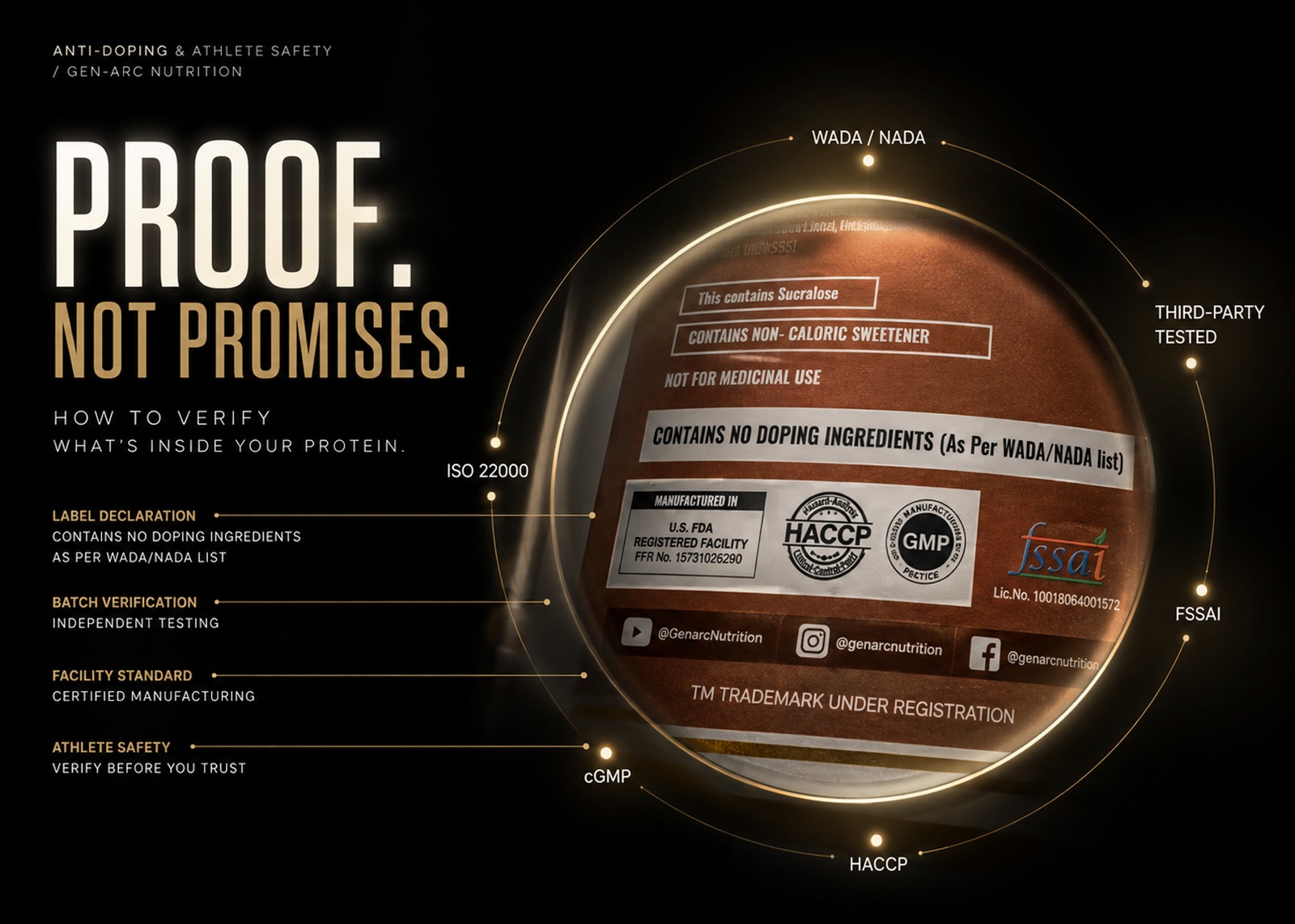
| WADA/NADA Compliance | Back of every Gen-Arc Whey tub states: Contains No Doping Ingredients (As Per WADA/NADA list). Printed on the product, not just in ads. |
| Third-Party Batch Testing | Every production batch is tested by an independent, NABL-certified lab, not just the original formula, every tub. |
| Facility Certifications | Manufactured in a US FDA-registered facility (Registration No. 15731026290) and certified to ISO 22000:2018 (Certificate No. 24RN09DA), alongside FSSAI, cGMP, and HACCP. This is where contamination risk is actually controlled. |
| Ongoing Verification | ISO 22000 certification requires regular surveillance audits. Batch testing happens on every production run. Certifications aren’t a one-time badge. |
Bottom line: WADA compliant, the gold standard for athletes in competitive sport who require verified assurance that their supplements contain no prohibited substances. With facility registration, certification numbers, and label proof behind it. Not a maybe.
Premium Protein: Same Standards, Different Goals.
Like every Gen-Arc supplement, this Whey Protein range is built to a global standard to boost your performance. It meets all the Gen-Arc standards we’ve discussed above for your safety: the same facility, the same batch-testing process, and the same compliance declaration on every label, regardless of category or flavor.
Whey Protein Isolate — Raw WPI 90 sourced from Poland, currently available in Coffee flavour. 27.18g protein, 5.9g BCAAs, and 5g Glutamine per scoop, built for athletes who want maximum purity and the fastest absorption window around training, with the same 5-enzyme digestive complex used across the range.
Whey Protein Blend — WPI 90 + WPC 80, available in Coffee and Kesar Badam flavours. 26.85g (Kesar Badam) & 26.63g (Coffee) protein, 5.65g BCAA, 4.5g Glutamine per scoop, with a more sustained-release profile, for athletes who want the same verified standard across a longer window. The Kesar Badam is infused with real saffron and almonds rather than artificial flavouring.
Whey Protein Concentrate — Raw WPC 80 from Poland, available in Coffee and Ras Malai flavours. 24.58g (Ras Malai), 24.41g (Coffee) protein, 5.5g BCAA and 4.4g Glutamine per scoop, for athletes who want an indulgent flavour. Real pistachio and traditional dessert notes in the Ras Malai, without stepping outside a tested, compliant formula.
Different training goals, different categories, different flavours — the same label declaration, the same batch-level testing, on every single one. Pick your category, then pick your flavour.
The Bottom Line
So, is your protein powder WADA compliant? For Gen-Arc Whey, the answer is a documented yes, backed by paperwork, not promises. The question was never really “is this a good protein powder for athletes.” Plenty are. The real question is whether you can prove what’s inside, on demand, with something more solid than a brand’s word for it.
For Gen-Arc, that proof already exists: on the label, in the batch reports, in the facility certifications. For any other product in your gym bag, it’s worth asking the same five questions before you trust it as much.
Disclaimer: This blog is for informational purposes only and does not replace an athlete’s own due diligence. Prohibited substance lists are reviewed and updated periodically by WADA and NADA. Always verify current status directly with your sport’s anti-doping authority before competition. Gen-Arc Nutrition provides batch testing and certification information to support informed choices; it is not a substitute for an athlete’s personal compliance responsibility.