Most athletes treat the post-workout shake as a habit. Finish the session, shake the bottle, move on. But the biology of what’s happening in your body during that window — and what your post-workout protein is actually entering — is more sophisticated than the habit suggests. Understanding this science, changes what you look for in a protein supplement, and why a protein formulation matters as much as the numbers on the label.
This is the science of what happens when amino acids reach your muscle tissue — and what separates a protein that performs from one that merely gets consumed.
What’s Actually Happening to Your Muscles Post-Workout
Resistance training creates controlled damage at the muscle fibre level. That stress causes tiny micro-tears in the muscle fibers. This isn’t damage you need to fear — it’s the trigger for adaptation. In the hours after training, your body flips a switch. It becomes highly sensitive to protein.
Immediately after training, the body shifts into a state of heightened sensitivity to amino acids. Muscle breakdown increases to clear out damaged tissue, but at the same time muscle building ramps up, called muscle protein synthesis (MPS) — the biological repair and growth process. Nutrient delivery to muscle is faster, and your cells are basically “waiting” for amino acids to start the repair process. The deciding factor is what you give your body.
Do you give your body amino acids quickly enough after training? If yes, you shift into net muscle growth. If not, you stay in a breakdown state. That’s why what and when you eat after training matters just as much as the workout itself.
What Your Muscles Need — and Why the Source Matters
The amino acids your muscles need post-workout are found in any complete dietary protein source. Chicken breast, eggs, fish, paneer, Greek yogurt — all valid protein sources that contribute meaningfully to daily intake and overall recovery. For most athletes, whole foods should form the backbone of daily protein nutrition.
But post-workout, the dynamics change. Solid food — however protein-rich — enters a digestive process that involves mechanical breakdown, fat and fibre digestion, and a gastric emptying time of 2–3 hours before amino acids meaningfully enter the bloodstream. At a moment when muscle tissue is most sensitive to amino acid availability, whole food simply can’t deliver fast enough to capitalise on the biological window.
For vegetarian athletes, the challenge is compounded. Plant-based whole food proteins — dal, lentils, paneer, soy — are valuable but frequently carry incomplete amino acid profiles individually. Leucine content, in particular, is lower in plant sources than in animal proteins, and leucine is the primary trigger for MPS activation. Research confirms that plant proteins generally deliver a lower leucine dose per gram of protein compared to whey, unless sources are deliberately combined or leucine is supplemented separately. (van Vliet et al., 2015 — J Nutr)
A high-quality whey protein supplement addresses both limitations simultaneously: liquid form accelerates gastric emptying and amino acid delivery, and whey’s amino acid profile — with approximately 11% leucine content and a complete essential amino acid spectrum — provides everything the muscle protein synthesis pathway needs, immediately and in the right ratios.
What Happens After Your Whey Shake: Understanding the Timeline
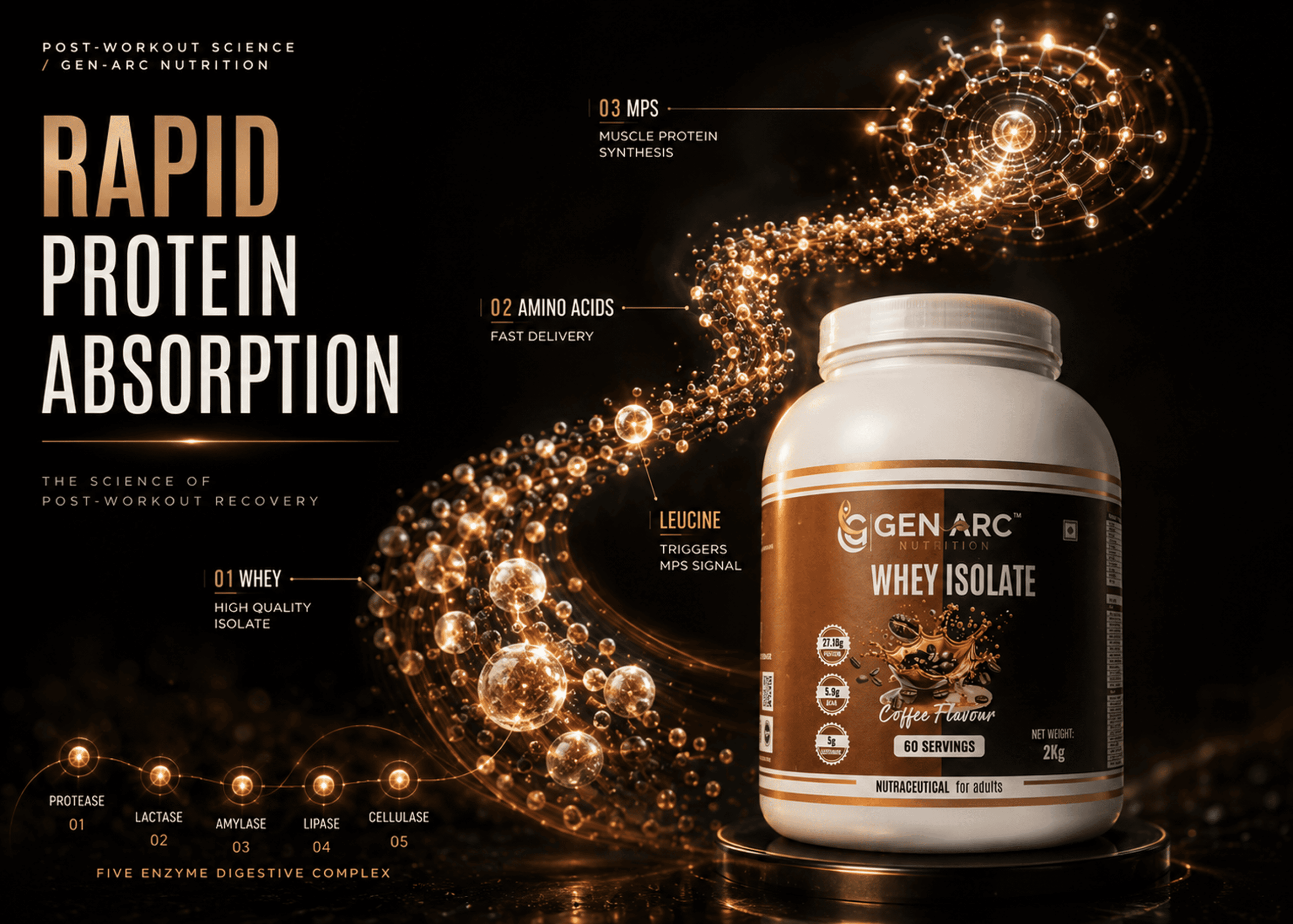
This is why whey is the go-to after training. It travels through a five-stage biological process — each stage determining how quickly and completely amino acids arrive at muscle tissue. Here’s what’s happening:
0–15 min: It hits your stomach. Whey in liquid form goes down easy. Unlike casein, which turns into a gel in your stomach and digests slowly, whey stays liquid. That means it moves out faster and doesn’t sit heavy.
15–30 min: It moves to your gut. A high-quality whey isolate is low in fat and lactose. That’s a good thing here, because fat and lactose slow digestion down. With isolate, whey empties out of your stomach quickly and heads to the small intestine where absorption actually happens.
30–60 min: It gets broken down. In your small intestine, enzymes start chopping the whey protein into amino acids — the actual building blocks. This is the stage where digestive enzymes help: exogenous protease accelerates hydrolysis; this speeds up the process so amino acids hit your blood even sooner.
60–90 min: Amino acids peak in your blood. Now the key amino acids show up: leucine, isoleucine, and valine — the BCAAs. Your blood amino acid levels jump. At the same time, whey triggers insulin. Insulin isn’t bad here. It acts like a shuttle, pushing those amino acids into your muscle cells.
1–3 hours: Muscle building turns on. Leucine flips the “build muscle” switch — the mTOR pathway. This is when muscle protein synthesis ramps up. With 20-40g of whey, this process can be ∼50% higher than normal. Your body shifts from breaking muscle down to building it up.
3–4 hours: Back to baseline. The amino acid spike fades. Muscle building slows down. Your body is ready for your next meal to start the process again.
Key references: Cermak et al. (2012) — PubMed ID 24257722; Churchward-Venne et al. (2012) — PMC3650697; Burd et al. (2012) — Applied Physiology, Nutrition & Metabolism
The Leucine Mechanism Most Athletes Don’t Know
Of all the amino acids in a post-workout shake, leucine does something the others don’t. It acts as a molecular signal — not just a building block. When blood leucine concentrations cross a threshold of approximately 2–3g per dose, the mTOR (mechanistic Target of Rapamycin) pathway is activated – thus initiating muscle protein synthesis.
The leucine content per serving is one of the most important numbers in a protein supplement, because below the leucine threshold, MPS is not stimulated regardless of how much total protein is consumed.
Whey protein naturally contains approximately 11% leucine by amino acid composition — among the highest of any common protein source. A 25g serving of whey isolate delivers approximately 2.75g of leucine, reliably clearing the mTOR activation threshold in a single dose. (Daniel Okafor, Clinical nutrition report)
The speed of leucine delivery amplifies this further. Whey isolate peaks in blood leucine concentration within 50–70 minutes of consumption. When muscle tissue sensitivity is highest — in the hours immediately following training — this rapid, threshold-clearing leucine delivery triggers the strongest possible MPS response from a single serving.
What Actually Drives Rapid Protein Absorption?
Knowing that fast absorption matters is one thing. Understanding what determines it in a specific supplement is what allows you to evaluate a product intelligently. Here are the five variables that govern post-workout protein absorption speed:
1. Protein Purity
Higher protein purity means less fat and carbohydrate in each serving — both of which slow gastric emptying. Whey isolate at 90%+ purity carries less than 1g fat and under 1.5g carbohydrate per serving, compared to concentrate at 70–80% purity, which carries 2–4g fat and 5–8g lactose. Less digestive load means faster transit from stomach to small intestine.
2. Lactose Content
Lactose slows gastric emptying and, for the majority of Indian adults who carry some degree of lactose sensitivity, creates a digestive burden that directly competes with protein absorption. Whey isolate’s near-zero lactose content removes this barrier almost entirely. Even in concentrate-based products, lactase enzyme supplementation substantially mitigates the delay.
3. Digestive Enzymes
This is where formulation goes beyond simply choosing isolate over concentrate. This is how GenArc’s five-enzyme mechanism works and what each enzyme contributes to post-workout absorption:
Protease — directly accelerates hydrolysis of protein chains into peptides and free amino acids, shortening the time to blood amino acid peak.
Lactase — breaks down residual lactose, eliminating the digestive delay and bloating response in lactose-sensitive individuals — critical for a significant proportion of Indian athletes.
Amylase — digests carbohydrates from the protein blend or mix, reducing fermentation-related bloating and supporting smooth gastrointestinal transit.
Lipase — processes residual fat content, ensuring fatty acids don’t slow gastric emptying or compete with amino acid absorption.
Cellulase — breaks down fibre components from flavouring or added ingredients, supporting overall digestive motility and transit efficiency.
4. Solubility and Mixability
A protein that mixes completely — no clumps — presents consistent surface area for gastric enzymes to act on and empties from the stomach uniformly. Poor mixability creates inconsistent amino acid delivery to the small intestine.
How Gen Arc Nutrition Formulates Whey Protein for Maximum Post-Workout Absorption
Gen Arc Whey Isolate (Coffee) and Whey protein Concentrate (Ras Malai, Coffee) are both formulated around the absorption factors above — distinct tools within the same post-workout strategy.
Gen Arc Whey Isolate (Coffee) — WPI 90, Poland-sourced
The post-workout primary. WPI 90 from Poland delivers 27.18g protein per 33g serving — 90%+ purity, under 1.4g fat, 0.2g sugar. BCAA content of 5.9g and 5g Glutamine per serving. Powered with the 5-enzyme digestive complex (Protease, Amylase, Lactase, Lipase, Cellulase) and improved bioavailability, this is the performance choice for fasted training or maximum absorption urgency.
Gen Arc Whey Concentrate (Coffee) — WPC 80, Poland-sourced
WPC 80 delivers 24.41g protein per 35g serving with 5.5g BCAAs and 4.4g Glutamine — a full amino acid profile at a slightly richer macronutrient profile. The 5-enzyme complex, including lactase specifically, addresses the lactose load in concentrate that would otherwise create digestive delay for sensitive individuals. For athletes who trained in a fed state or are using protein between meals as well as post-workout, concentrate delivers everything the MPS pathway needs.
Both products are sourced from a premium certified Polish source— WPI 90 and WPC 80 respectively — manufactured in a US FDA-registered facility, and certified with FSSAI, cGMP, HACCP, and ISO standards. Every batch is independently tested in NABL-certified laboratories for purity, safety, and consistency. WADA and NADA compliant — verified safe for competitive athletes.
Crafting High-Quality Nutrition for a Stronger India
The post-workout protein shake’s value is determined entirely by how efficiently it delivers amino acids to primed muscle tissue in the window when the biological conditions for repair and growth are most favourable. Protein purity, leucine content, digestive enzyme support, lactose load, and manufacturing integrity are variables that determine whether your post-workout protein is performing at the level your training demands.
At Gen-Arc, we didn’t just make another protein. We worked directly with athletes, nutrition scientists, and lab research to solve the gaps we kept seeing in what’s available in India today. The result: formulations that are clean, digestible, and obsessively tuned to help gym-goers and athletes in India reach their goals — and stay there. This is nutrition engineered for performance.
Explore the full Gen-Arc Nutrition range of Performance Nutrition.