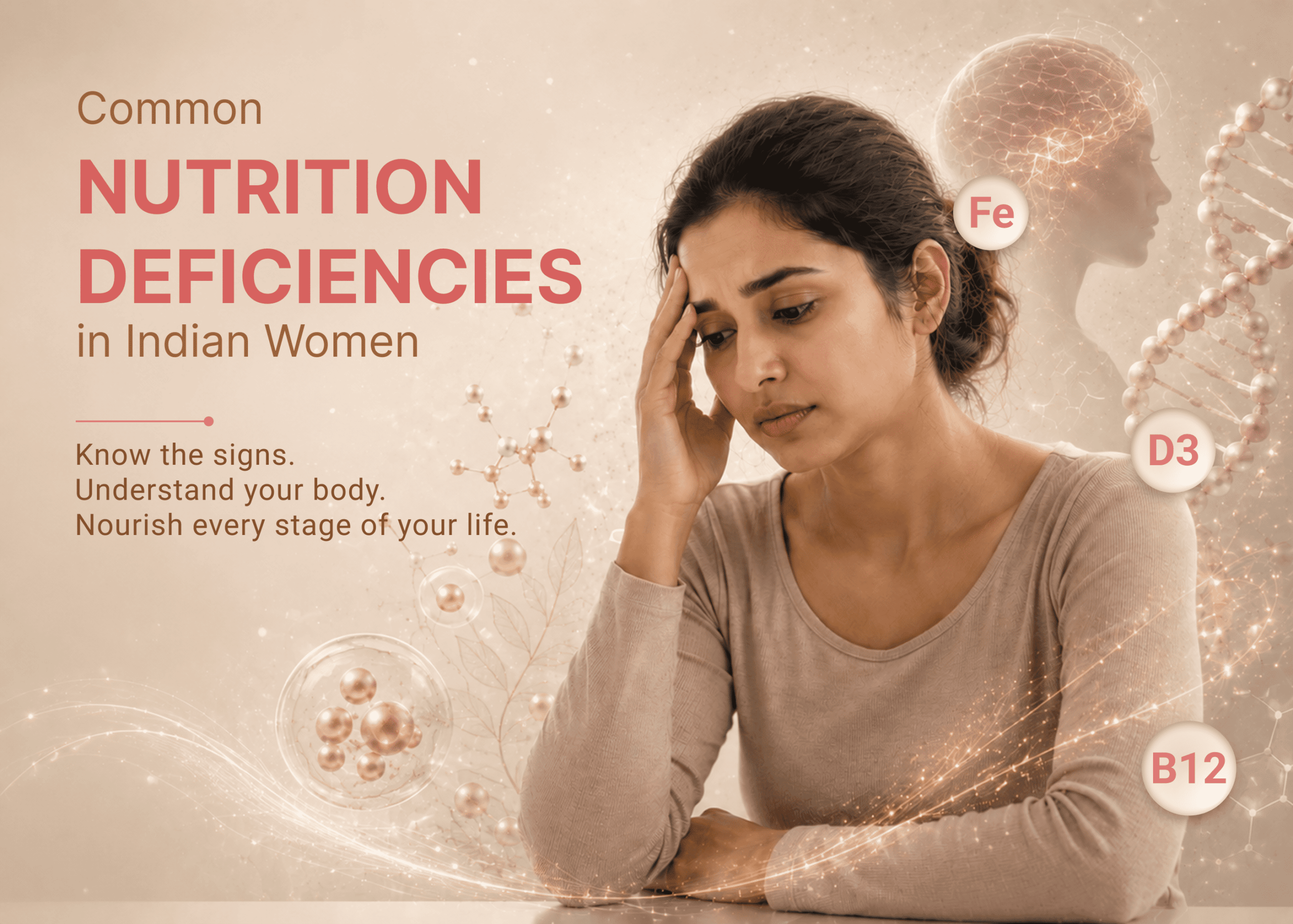
Did you know a woman’s nutritional needs don’t stay constant? Women’s bodies go through several transitions and their nutritional needs shift at every stage of life. Growing girls need iron and calcium. Menstruation creates a monthly drain on iron stores that many women never fully recover from. Pregnancy and motherhood place extraordinary demands on protein, folate, and B12. Common hormonal conditions such as PCOS disrupts hormonal balance and affects how nutrients are processed. And perimenopause and menopause accelerate bone loss and vitamin D depletion before the symptoms are visible.
Through every single one of these transitions, most Indian women are running on a nutritional deficit they don’t know they have. This is because the conversation around women’s health has, for too long, focused on everything except what nourishes it.
The Reality of India’s Women’s Health
A 2021 systematic review covering 67 studies across India found that micronutrient deficiencies are not the exception among Indian women. Iron deficiency affects 54–67% of women of reproductive age. Vitamin D deficiency affects 61–70%, despite India being one of the sunniest countries in the world. Vitamin B12 deficiency affects 37–53%, with vegetarian women at the highest risk. And on protein — a study of 785 households across six Indian states found that only 18% of households met their daily protein requirement.
Many of these women across the studies are educated, urban, and eating three meals a day. The crisis is hidden — in the quality of what we eat, in deeply embedded cultural habits around food, and in a persistent lack of awareness that protein and micronutrients are as essential to a woman’s health as they are to anyone else’s.
Common Nutrition Deficiencies Most Indian Women Are Living With
1. Iron deficiency
This is one of India’s most under-recognised and common nutritional deficiency among women. Every menstrual cycle creates a monthly loss of iron that, without consistent dietary replacement, accumulates into a deficit over time. By the time a woman reaches pregnancy, her iron stores may already be significantly depleted.
Iron Deficiency Signs that are often missed:
→ Persistent fatigue that sleep doesn’t fix — not tiredness, but a bone-deep exhaustion → Shortness of breath on mild exertion, when climbing stairs, walking quickly
→ Cold hands and feet, even in warm weather
→ Brittle nails with vertical ridges or spoon-shaped indentations
→ Difficulty concentrating
→ Pale inner eyelids or gums
Good food sources for iron deficiency to choose from:
- Dark leafy greens — spinach, methi, amaranth
- Lentils and legumes — masoor dal, rajma, chana
- Sesame seeds, pumpkin seeds, and jaggery
- Eggs and lean meat for those who consume animal protein
- Pair iron-rich foods with vitamin C (amla, lemon) to improve absorption
- Avoid tea or coffee within an hour of meals
- If you suspect iron deficiency, ask your doctor for a full iron panel, checking Ferritin levels tell a more complete story.
2. Vitamin D
Doesn’t it seem counterintuitive? How can a country with so much sunlight have a vitamin D deficiency crisis? But the reality lies in how urban Indian women actually live: in offices, behind glass, under SPF, in full-coverage clothing, in cities with heavy air pollution that blocks UVB rays. The body synthesises vitamin D from direct sunlight on skin, and most women simply aren’t getting it.
Vitamin D Signs that women must not overlook:
→ Generalised body aches and muscle weakness
→ Low mood, irritability, or mild depression
→ Frequent infections and slow recovery
→ Hair thinning beyond what seems seasonal
→ Bone pain, particularly in the lower back, hips, or legs
How to improve Vitamin D?
- 15–20 minutes of direct morning sunlight (before 10 AM) on arms and legs — daily, not occasionally
- Fatty fish (salmon, mackerel), egg yolks
- Supplementation is often necessary — but get your vitamin D levels tested first to understand your baseline.
3. Vitamin B12
Vitamin B12 is found almost exclusively in animal-derived foods — meat, fish, eggs, and dairy. Women on vegetarian or vegan diets who aren’t actively supplementing are almost certainly deficient. But B12 deficiency develops slowly and silently, which is why it’s often caught late, when symptoms are already pronounced.
Signs to look for in Vitamin B12 deficiency:
→ Tingling or numbness in hands and feet
→ Memory lapses, brain fog, difficulty processing information
→ Mouth ulcers that recur frequently
→ A smooth, swollen, or inflamed tongue
→ Low mood or anxiety that doesn’t have an obvious cause
→ Fatigue alongside paleness
How to improve Vitamin B12 levels?
- Dairy — milk, curd, paneer — daily and consistently
- Eggs, if your diet allows
- Supplementation is highly recommended for vegetarian women — B12 is one nutrient where food alone often cannot close the gap
4. Protein
“Protein is for gym-goers.” It’s an assumption so embedded in Indian culture that most women don’t consider it relevant to their own health. But protein is the structural material of every cell in your body — your hormones, your immune cells, your hair, your muscle, your skin.
Signs your body needs Protein:
→ Hair fall that seems disproportionate to seasonal change
→ Muscle weakness or loss of tone — particularly noticeable after 35
→ Slow wound healing
→ Feeling hungry shortly after meals
→ Brittle nails and dry, thin skin
→ Frequent illness
How to improve Protein levels for women?
- Consume a protein source at every meal
- Dal and legumes paired with dairy or grains for better amino acid coverage
- Curd, paneer, eggs, nuts, and seeds as consistent daily staples
- A clean, quality protein supplement when dietary intake consistently falls short
Understanding the Supplements You Take
The supplement market in India is on an upward growth trajectory — making promises with products for every deficiency, in every format, at every price point. While some are backed by genuine science and rigorous manufacturing standards, many often are not.
Before you add any supplement to your routine: get your blood levels tested for the nutrients you’re concerned about — don’t supplement by assumption. Speak to your doctor or a certified nutritionist about the right form and dose for your specific situation. And when you choose a product, ask: Is it third-party lab tested? Is the source of the key ingredient verified? Are there unnecessary fillers, artificial sweeteners, or additives? Is the brand certified by a recognised food safety body?
Supplements are not a substitute for a good diet. But for the right woman, at the right stage of life, with the right deficiency — the right supplement is not optional. It’s the difference between managing and thriving.
Gen Arc Nutrition: Building Healthier, Stronger Women in India
Gen Arc Nutrition’s philosophy is simple: every Indian deserves access to nutrition that is honest, scientifically sound, and built for the way we actually live. It means formulating for specific life stages, not generic populations.
That means sourcing premium-quality whey for our performance range — because the origin of a protein directly determines its amino acid profile, digestibility, and purity. Crafting products such as Mom ARC for the nutritional demands of pregnancy and postpartum recovery; Kid ARC and Power ARC for the developmental needs of growing children. Developing thoughtful formulations with distinct micronutrient profiles that Indian women need in the Wellness and Radiance range, that women need across the arc of their lives.
Explore the entire range of Wellness for Women at GenArc nutrition
Every product is third-party lab tested in NABL-certified laboratories, certified by FSSAI, and manufactured in facilities that meet cGMP, ISO, and international quality standards.
Women’s health in India deserves the same rigour, the same quality of ingredients, and the same depth of thought that goes into any world-class supplement. That’s the standard we hold ourselves to — and the standard you should expect from everything you put into your body.