By Gen Arc Nutrition | Protein Timing · Muscle Protein Synthesis · Whey Isolate · Performance Supplements · Lean Muscle
Most people spend months debating which protein to buy — isolate vs concentrate, whey vs plant-based, one brand versus another — but give almost no thought to when they’re taking it. That’s not a small oversight. Protein timing, done right, is one of the few variables in nutrition that has consistent, replicated clinical evidence behind it.
The caveat — and it matters — is that timing is the amplifier, not the foundation. Total daily protein intake is the non-negotiable base. With timing the protein intake, you’re giving your body the best possible conditions to build lean muscle, recover efficiently, and adapt to the training load you’re placing on it.
The Foundation: Hit Your Daily Target First
Before timing means anything, your total daily protein intake has to be right. The research consensus for strength and hypertrophy-focused athletes sits at 1.6 — 2.2g of protein per kilogram of bodyweight per day. For a 75kg athlete, that’s 120–165g of protein across the day. For an 85kg athlete pushing hard in powerlifting or Hyrox, it’s closer to 136–187g.
An athlete who nails their timing but consistently falls short of their daily total will always underperform one who hits their number and distributes it imperfectly. Total protein is the prerequisite. Timing is the optimisation.
With that established — here’s what the evidence says about when to take your protein for maximum effect.
The Anabolic Window: What the Research Actually Shows
For years, gym culture operated on a simple rule: take your protein within 30 minutes of finishing your workout or the gains are gone. The “anabolic window” was treated like a closing door — miss it and you’ve wasted the session.
A landmark 2013 meta-analysis examining protein timing and its effects on muscle strength and hypertrophy found that while post-workout protein does meaningfully support muscle protein synthesis (MPS), the window is substantially wider than previously believed — extending to 4–6 hours surrounding exercise, not 30 minutes after it. (Schoenfeld et al., 2013 — PMC3879660)
A separate 2013 study on protein distribution found that muscles remain responsive to protein-driven MPS for up to 24 hours post-workout — meaning a single missed post-workout shake is far less catastrophic than gym folklore suggests, but consistent protein distribution across the day is far more important than most athletes realise. (Areta et al., 2013 — PMC3650697)
The practical implication: stop panicking about the exact minute you take your post-workout shake. Start thinking about protein as a day-long strategy with training as the centrepiece.
The Four Timing Strategies — and the Evidence Behind Each
1. Post-Workout — The Strongest Single Timing Window
Post-workout protein remains the most evidence-backed single timing strategy. Within two hours of resistance training, muscle tissue is primed for amino acid uptake — protein synthesis rates are elevated, GLUT4 receptors are active, and the cellular machinery for repair and adaptation is engaged.
This is where fast-absorbing protein earns its advantage. Whey isolate, with peak amino acid absorption occurring within 60–90 minutes of consumption, is the optimal protein source for this window. Its near-zero fat and lactose content means minimal digestive delay — amino acids reach muscle tissue quickly, when demand is highest.
Gen Arc Whey Isolate (Coffee) — WPI 90, Poland-sourced — delivers 27.18g protein, 5.9g BCAAs, and 5g Glutamine per 33g serving, with the 5-enzyme digestive complex ensuring maximum absorption at exactly the moment muscle tissue needs it.
2. Pre-Workout + Post-Workout — The Strongest Combination
A 2018 study found that distributing protein intake both before and after training — with 4–6 hours between doses — produced the greatest improvements in total muscle mass compared to either timing alone. (Schoenfeld & Aragon, 2018 — VeryWellHealth)
Pre-workout protein (20–30g, 60 minutes before training) delays muscle protein breakdown during the session and increases circulating amino acid levels, so the anabolic response post-workout is amplified. For athletes who train in the afternoon or evening, this pre + post model is the most effective single protocol available.
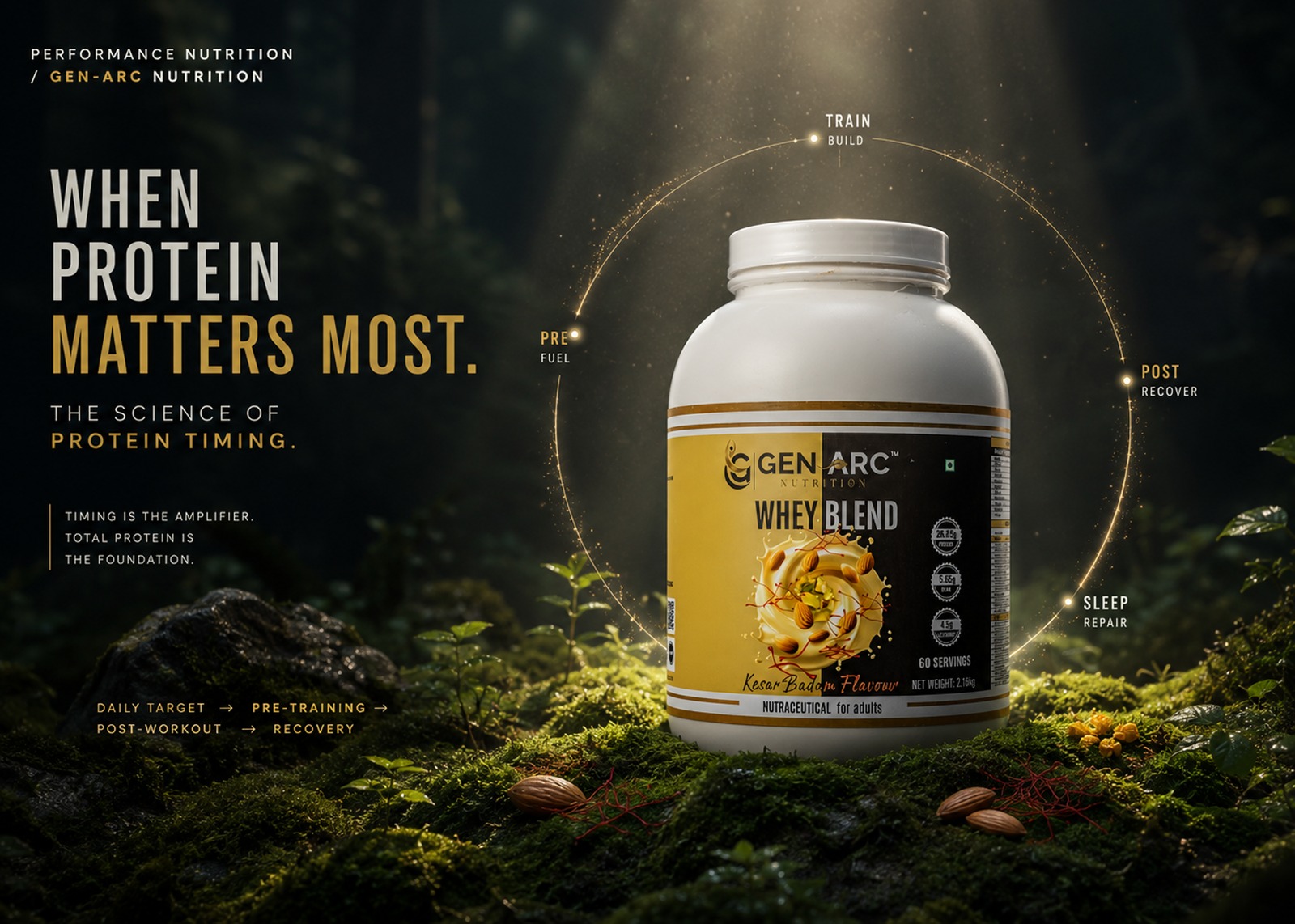
Gen Arc Whey Concentrate (Coffee) — WPC 80, Poland-sourced — is well-suited for the pre-workout protein window: 24.41g protein, 5.5g BCAAs, 4.4g Glutamine per 35g serving. Slightly slower-digesting than isolate, it supports sustained amino acid availability across the training session. Gen Arc Whey Blend (Kesar Badam) — combining WPI 90 and WPC 80 — offers the same sustained pre-workout profile with 26.85g protein and 5.65g BCAAs per serving.
3. Before Sleep — Recovery While You Rest
A 2016 study demonstrated that 30–40g of protein consumed before sleep meaningfully increased overnight MPS and improved recovery compared to a placebo — with benefits particularly pronounced in older adults and those in high-volume training blocks. (Snijders et al., 2016 — ScienceDirect)
The mechanism: during sleep, the body enters its most significant recovery and repair window. Without available amino acids, MPS is limited by substrate availability. A pre-sleep protein dose removes that constraint. A well-formulated blend like Gen Arc Whey Blend delivers a mixed absorption profile that sustains amino acid availability across the sleep period.
4. Even Distribution Across the Day — The Most Underrated Strategy
The 2013 Areta et al. study compared three protein distribution patterns in trained athletes: bolus (one large dose), intermediate (four evenly-spaced moderate doses), and pulse (eight small doses). The intermediate pattern — 20–40g every 3–4 hours — produced the greatest muscle protein synthetic response across the day. (Areta et al., 2013 — PMC3650697)
The practical takeaway: one large protein dose (say, 60g post-workout and nothing else) is less effective than spreading equivalent protein across four meals and a shake. MPS has a ceiling per dose — roughly 20–40g depending on training status and body weight — and excess protein beyond that threshold in a single sitting doesn’t proportionally increase muscle building.
Timing by Workout Schedule: The Practical Guide
Your optimal protein timing protocol depends on when you train. Here’s how to map the Gen Arc range to your schedule:
| Workout Time | Pre-Workout Formula | Protein Timing | Recommended Product |
|---|---|---|---|
| Morning 6–9 AM | Take Pre-Workout 20–30 min before training | Protein shake within 2 hrs post-session (breakfast window) | Whey Isolate (Coffee) 27.18g protein, fast absorption |
| Afternoon 12–3 PM | Take Pre-Workout 20–30 min before training | Pre-training protein 1 hr before + Post-training within 2 hrs (4–6 hrs apart) | Pre: Whey Blend (Kesar Badam) 26.85g protein Post: Whey Isolate (Coffee) |
| Evening 6–9 PM | Take Pre-Workout 20–30 min before training | Pre-training protein 1 hr before + Post-training shake + Consider pre-sleep dose | Pre: Whey Concentrate (Coffee) WPC 80, 24.41g protein Post: Whey Isolate (Coffee) 27.18g protein Sleep: Whey Blend (Kesar Badam) WPI 90 + WPC 80 combined, 26.85g protein |
Where Pre-Workout Fits Into the Protein Timing Picture
Pre-workout isn’t just an energy tool — it directly affects how well your post-workout protein performs.
The 6200mg of L-Citrulline Malate in Gen Arc Pre-Workout (Pink Guava / Lychee) drives nitric oxide production, which dilates blood vessels and increases nutrient delivery to working muscle tissue. That means more oxygen during training — and critically, more efficient amino acid delivery in the post-workout window. The protein you take after training reaches muscle tissue faster and in higher concentration when blood flow to those muscles is already elevated.
Beta-Alanine (3200mg) extends your capacity for high-intensity work — more volume per session means a greater stimulus for adaptation, which means your post-workout protein has more repair and growth work to support. Taurine (1200mg) and L-Tyrosine (1500mg) maintain output and focus into the later stages of the session, when technique and training quality typically drop off.
The protocol works as a system: pre-workout primes the environment, training creates the stimulus, post-workout protein supplies the raw material for adaptation. Each element makes the next one more effective.
The Gen Arc Range: One Protocol, Three Proteins
Each product in the Gen Arc range has a distinct role within a complete protein timing strategy. All three are Poland-sourced, WADA and NADA compliant, manufactured in a US FDA-registered facility, certified with FSSAI, cGMP, HACCP, and ISO standards, and third-party lab tested in NABL-certified laboratories every batch.
The athlete who takes protein at the right times, in the right amounts, from products that actually absorb — and does so consistently across the training week — will outperform the one who obsesses over any single variable in isolation. Hit your daily target. Distribute it across the day. Get protein around your training. Let the pre-workout prime the environment. And use products built to the standard your training demands.
Explore the entire high-performance protein range