
By Gen Arc Nutrition | Pre-Workout · Caffeine · Beta-Alanine · Citrulline · Performance Supplements
Every serious gym-goer has stood in front of a pre-workout tub at some point and asked the same honest question: does this actually do anything?
It’s a fair question — and the supplement industry hasn’t always made it easy to answer. Between exaggerated marketing claims, proprietary blends that hide actual dosages, and products loaded with stimulants that deliver a crash more than a performance edge, the pre-workout category has earned its sceptics.
Here’s the more useful question: do the specific ingredients inside a pre-workout work — and at what dose? Because that’s where science actually lives. And for the right athlete, in the right training context, the answer is a clear yes.
What Pre-Workout Actually Is
A pre-workout supplement is a multi-ingredient formula designed to be taken 20–30 minutes before training to enhance performance across three primary variables: energy and focus, muscular endurance, and blood flow and nutrient delivery to working muscles.
The word “formula” is important here. Pre-workout isn’t a single compound — it’s a stack. The performance benefit comes from how the ingredients interact, complement, and amplify each other. A well-constructed pre-workout is essentially a precision performance tool. A poorly constructed one is an overpriced caffeine hit with a lot of marketing copy on the label.
The difference between the two comes down to one thing: clinical dosing. Every active ingredient needs to be present at the dose the research established as effective — not just an amount to be included on the label.
The Ingredients — and What the Science Actually Says
Here’s a breakdown of the five core ingredients in a clinically dosed pre-workout formula, what they do, and what the research shows.
Caffeine — 200mg
Caffeine is the most researched performance compound in sports nutrition — full stop. It works by blocking adenosine receptors in the brain, which suppresses the accumulation of fatigue signals during training. The practical effect: you can push harder for longer before the session feels difficult. A clinical trial demonstrated that caffeine supplementation enabled men to lift significantly heavier loads across compound movements including deadlift and bench press compared to placebo. Research consistently shows a 10–15% improvement in strength and peak power output with caffeine at effective doses.
Evidence: Goldstein et al. (2010), Journal of the International Society of Sports Nutrition — PubMed ID 20205765
L-Citrulline Malate — 6200mg
Citrulline malate is the pump ingredient — but the performance case goes well beyond aesthetics. Citrulline is converted to arginine in the kidneys, which drives nitric oxide production, dilates blood vessels, and increases oxygen and nutrient delivery to working muscle tissue. At 6–8g, research from McMaster University and the Australian Institute of Sport found that the combination of caffeine and citrulline produced 12–18% more total training volume compared to placebo. For athletes training at high intensity across multiple sets, that volume increases compounds meaningfully over a training block.
Beta-Alanine — 3200mg
Beta-alanine is the endurance ingredient — specifically for high-intensity efforts lasting 60 seconds to 4 minutes, which covers most strength training sets, sprints, and HIIT intervals. It works by increasing muscle carnosine levels, which buffers the hydrogen ion accumulation (the burn) that forces you to stop or slow down before your muscles are truly exhausted. Research shows 12–20% more repetitions in high-intensity sets of 10+ reps with consistent beta-alanine use. One note for beginners: beta-alanine causes a harmless tingling sensation — paraesthesia — in the face, neck, and hands at clinical doses. It’s not an allergic reaction. It’s the compound working. It typically subsides after 2–3 weeks of consistent use.
Evidence: https://www.mdpi.com/2072-6643/16/14/2340
Taurine — 1200mg
Taurine works in two directions simultaneously: it supports lactate clearance during high-intensity exercise, delaying the metabolic fatigue that accumulates in longer sessions, and it modulates the stimulant effect of caffeine — smoothing the energy curve and reducing the jittery edge that caffeine alone can produce in some individuals. A clinical study found that two weeks of caffeine and taurine supplementation combined meaningfully enhanced endurance performance and significantly decreased lactate accumulation across long-distance running. A separate trial showed a 13% improvement in upper-body muscular endurance versus placebo.
L-Tyrosine — 1500mg
L-Tyrosine is the focus ingredient — and it addresses something that caffeine alone doesn’t: mental performance under physical stress. During intense training, cognitive demands are high — technique, tempo, cueing, competitive awareness. Tyrosine is a precursor to dopamine and noradrenaline, neurotransmitters that regulate focus, motivation, and reaction time. Research shows that tyrosine supplementation maintains cognitive function and mood under physically stressful conditions where performance would otherwise decline. Paired with taurine, it also offsets the jitteriness and post-session crash that caffeine-only products tend to produce.
What You’ll Actually Feel — and When
First session expectations matter — because misaligned expectations are why most beginners either think pre-workout doesn’t work, or think something has gone wrong.
Acute effects — from the first dose:
Energy and alertness: noticeable within 20–30 minutes. Caffeine and tyrosine working together. Clean, focused energy — not the heart-racing spike of a high-stimulant product.
The tingle: beta-alanine paraesthesia typically hits 15–20 minutes in. Harmless, temporary. First-timers: do not panic.
Pump and vascularity: citrulline malate effect becomes apparent mid-session as blood flow increases to working muscles.
Consistent use (2–4 weeks):
12–18% more training volume: the cumulative effect of better endurance, less fatigue accumulation, and more consistent output across sets.
The tingle reduces: muscle carnosine saturation builds over time, which dampens the paraesthesia effect.
Enhanced lean body mass: studies using pre-workout stacks with HIIT protocols over 4+ weeks show improvements in lean mass and VO2max — the result of training harder, more consistently, with better recovery between sets.
Side Effects: The Honest Version
Pre-workout side effects are real — but they’re almost entirely dose-dependent and product-quality dependent. Here’s what’s worth knowing:
Beta-alanine tingling: harmless, temporary, subsides with consistent use. Not a side effect in the clinical sense — it’s a physiological response to an active ingredient doing its job.
Overstimulation: if you’re caffeine-sensitive, 200mg may feel like a lot, particularly if you’ve already had coffee that morning. Start with half a serving on your first use to assess tolerance.
Sleep disruption: caffeine’s half-life is approximately 5–6 hours. Taking pre-workout after 5pm will likely affect sleep quality. Time your session accordingly.
Cardiovascular sensitivity: pre-workout is not appropriate for individuals with hypertension, arrhythmia, or other cardiac conditions. If in doubt, consult a doctor before use.
Artificial additives in low-end products: many affordable pre-workouts on the market carry artificial sweeteners, synthetic dyes, and undisclosed fillers that can cause gut discomfort and blunt absorption. This is a product quality issue, not an inherent pre-workout problem.
A clean-formula pre-workout — zero added sugar, naturally flavoured, no artificial sweeteners or preservatives — eliminates most of the product-quality side effects by design.
Who Should Take Pre-Workout — and Who Shouldn’t
Pre-workout is a performance tool, not a daily supplement. It’s most valuable when the training demands it.
Pre-workout makes sense if:
You’re training for PRs, peak strength output, or competition — where a 10–15% increase in power matters.
You’re doing high-intensity work: bodybuilding, powerlifting, Hyrox, sprinting, HIIT — training styles where muscular endurance and energy systems are both under load.
You’re training at high frequency and need consistent output across sessions, not just occasional strong days.
You want clean, crash-free energy without the unpredictability of high-stimulant products.
Pre-workout is not the right tool if:
You’re a casual gym-goer doing 3 light sessions a week — a black coffee will give you comparable energy at a fraction of the cost.
You have cardiac conditions, hypertension, or are pregnant — the caffeine and stimulant load is not appropriate.
You’re under 18. Clinical dosing for adult physiology is not safe for adolescents.
You’re caffeine-dependent already and using pre-workout to compensate for poor sleep — the compound effect on adrenal load is not a performance strategy.
Gen Arc Pre-Workout: Built to the Clinical Standard
Gen Arc Pre-Workout (Pink Guava / Lychee) is formulated around one principle: every ingredient at the dose the research established as effective. No prop blends. No token inclusions. No artificial sweeteners, zero added sugar, naturally flavoured.
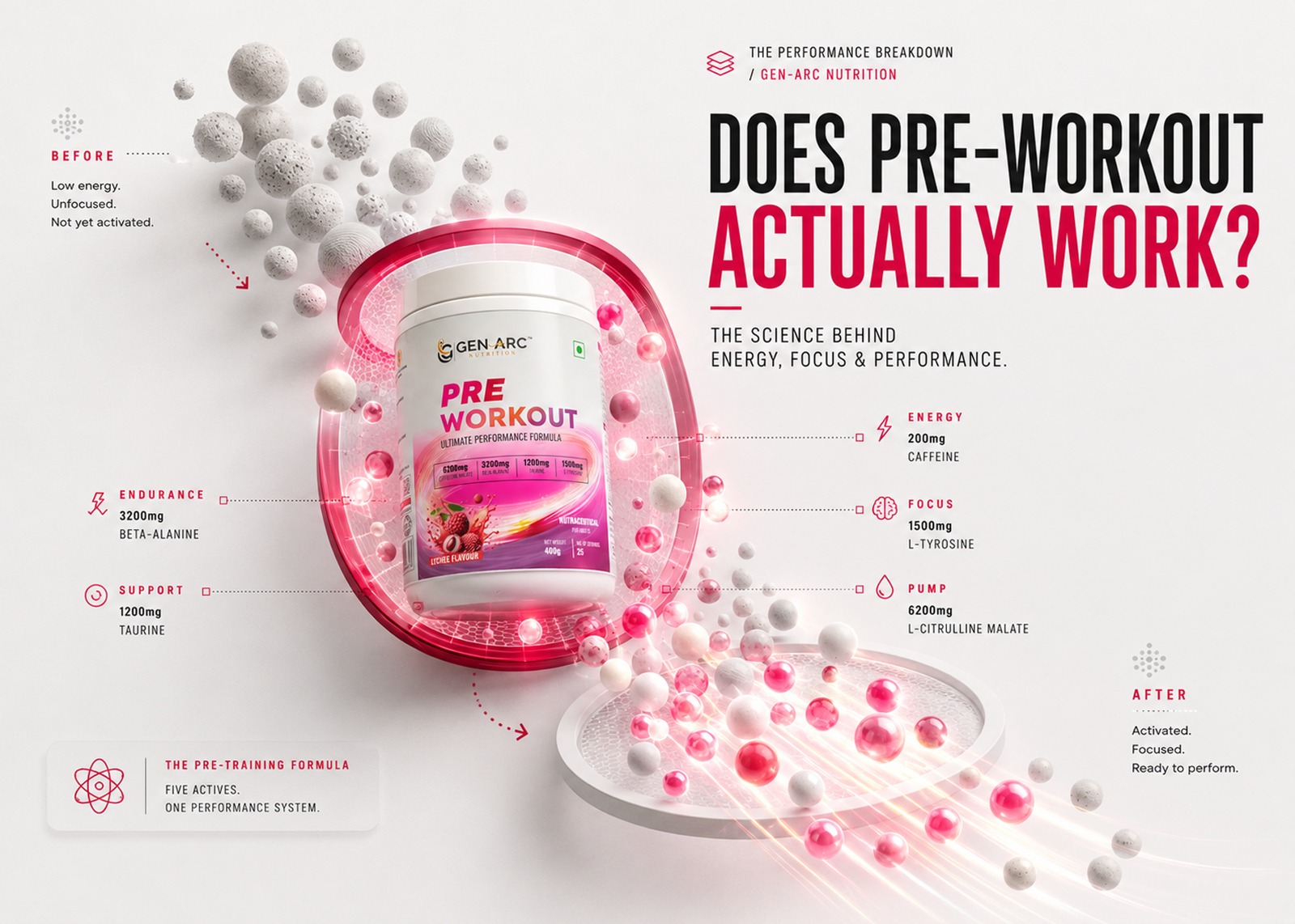
The formula: 6200mg L-Citrulline Malate, 3200mg Beta-Alanine, 1200mg Taurine, 1500mg L-Tyrosine, 200mg Caffeine. Clinically dosed across all five active ingredients — meaning the numbers on the label are the doses the studies used, not approximations designed to get them on the ingredient list.
It is WADA and NADA compliant — independently verified as free from prohibited substances, making it safe for competitive athletes subject to testing. Every batch is third-party lab tested in NABL-certified laboratories for purity, safety, and consistency. For competitive athletes, that verification isn’t optional.
What you’ll get from a clinically dosed, clean-formula pre-workout used consistently with serious training:
10–15% more strength and peak power output — caffeine at effective dose, session one.
12–20% more reps across high-intensity sets — beta-alanine and citrulline working together on endurance and blood flow.
12–18% more total training volume — the caffeine-citrulline synergy compounding across the session.
Sharper mental focus under fatigue — tyrosine and taurine maintaining cognitive performance when the session gets hard.
Clean energy, no crash — zero sugar, no artificial stimulant spikes, nothing your gut needs to fight.
So, does pre-workout work?
The ingredients do — when they’re present at the right doses, in a formula that’s been verified, not just labelled. For athletes training seriously, a clinically dosed pre-workout isn’t a luxury. It’s a precision tool that closes the gap between the session you’re capable of and the session you’re actually delivering.