Prenatal Nutrition · Pregnancy Protein · Folic Acid · Women’s Health
It’s 11 pm. You’re twelve weeks pregnant, you haven’t been able to keep much food down today, and you’re Googling: “is protein powder safe during pregnancy?“ You want a real answer, not a cautious non-answer.
You’re not alone. Protein during pregnancy is one of the most searched — and most misunderstood — nutrition topics for expecting mothers. There’s a lot of noise: well-meaning family advice, conflicting articles, and a supplement industry that hasn’t always made things easy to trust.
So let’s talk this through by discussing six of the most common myths about protein powder during pregnancy.
MYTH 1
“Protein powder is unsafe during pregnancy.”
THE FACT
Protein needs actually increase during pregnancy — significantly. Most guidelines recommend 70 to 100 grams of protein per day for pregnant women, compared to roughly 46–55 grams for non-pregnant adults. Your body is building an entirely new human being; the demand for amino acids for fetal tissue, organ formation, and placental development is real and substantial.
The concern people have about protein powders during pregnancy isn’t really about protein — it’s about what else might be in the product. Artificial sweeteners, undisclosed heavy metals, poorly regulated ingredients, and high-stimulant formulas are legitimate concerns. This is exactly why the quality of the product matters: look for lab-tested, certified, naturally sweetened formulations with no added sugar and a clean ingredient list.
* Always consult your OB-GYN or gynaecologist before introducing any new supplement during pregnancy.
MYTH 2
“I eat a balanced diet — I’m getting enough protein.”
THE FACT
This one comes from a good place. You’re eating consistently, you’re not skipping meals, you feel like you’re doing the right things. But the math often doesn’t add up.
A typical day of “balanced eating” for many Indian pregnant women looks like this:
two chapatis, a bowl of sabzi, some curd, and some fruit. This delivers somewhere between 30 and 45 grams of protein. That’s roughly half of what the body actually needs during pregnancy. When you factor in nausea, food aversions, and the sheer exhaustion that makes cooking a full meal feel impossible, the gap gets wider.
Protein deficiency during pregnancy has been associated with low birth weight, poor fetal muscle development, and slower recovery for the mother postpartum. Filling a genuine nutritional gap with a clean, purpose-built supplement isn’t a shortcut — it’s sensible.
* Nutritional needs vary by trimester, weight, and health conditions. Consult your doctor or a certified nutritionist for personalised daily protein targets.
MYTH 3
“Dal, roti, ghee, and laddoos — traditional home-cooked food covers everything.”
THE FACT
This myth lives in every Indian household, and it comes from love. The ghee is for lubrication, the laddoos are for strength, the dal is for protein. And there is truth in some of it — traditional Indian food has real nutritional value when thoughtfully prepared.
But here’s what is in the laddoos: a standard methi or gond laddoo, made with ghee, sugar or jaggery, and flour, delivers primarily calories and fat. The jaggery provides some iron, but in quantities too small to meaningfully address pregnancy-level iron requirements. The ghee adds healthy fats but no protein, no folic acid, no Omega-3.
For vegetarian women in particular — who have no access to the complete amino acid profiles found in eggs, fish, or meat — relying on dal alone means relying on incomplete proteins that need careful combining to deliver full nutritional value. Most daily diets, even well-intentioned ones, don’t achieve that combination consistently.
Traditional food is a foundation, not a complete solution. Supplementing smartly fills the gaps that tradition — and good intentions — leave behind.
* Vegetarian and vegan pregnant women are at higher risk of protein, iron, and B12 deficiency. Medical guidance is strongly recommended.
MYTH 4
“Folic acid only matters in the first trimester.”
THE FACT
Folic acid gets the most attention in the first trimester because of its critical role in preventing neural tube defects in the early weeks of fetal development. But its importance doesn’t stop there — and it doesn’t start at conception either.
Folic acid supports DNA synthesis, red blood cell production, and healthy cell division — all processes that continue throughout pregnancy. Iron works alongside folic acid to prevent anaemia, which remains one of the most common and underdiagnosed health issues among pregnant women in India, affecting energy levels, oxygen delivery to the baby, and recovery postpartum.
Beyond pregnancy itself: adequate folate levels before conception reduce the risk of complications significantly. And after delivery, both folic acid and iron continue to support the mother’s recovery and the baby’s early development during breastfeeding. This is a nutrient that needs to be present at every stage — pre-conception, all three trimesters, and postpartum.
* The recommended daily intake of folic acid during pregnancy is 400–600 mcg, and up to 500 mcg during breastfeeding. Consult your doctor for dosage guidance specific to your health history.
MYTH 5
“Protein supplements will make me gain too much weight.”
THE FACT
Weight anxiety during pregnancy is real, and it’s valid. But protein — especially lean, low-sugar protein — is not the cause of unhealthy weight gain during pregnancy. Excess refined carbohydrates, added sugar, and calorie-dense but nutritionally empty foods are.
Adequate protein intake during pregnancy actually supports healthy weight management. It keeps you satiated longer, reduces cravings for empty-calorie foods, supports lean muscle maintenance, and helps regulate blood sugar — which matters especially for women at risk of gestational diabetes.
The key is what’s in the supplement. Zero added sugar, natural sweeteners, and a clean macronutrient profile mean that a protein supplement adds nutritional value — not empty calories. It’s the laddoo with 40 grams of sugar you might want to reconsider, not the clean protein scoop.
* Healthy gestational weight gain depends on your pre-pregnancy BMI. Your doctor or nutritionist can give you a personalised target.
MYTH 6
“Any regular protein powder works — I don’t need a pregnancy-specific one.”
THE FACT
This is perhaps the most important myth to address — and the one with the most practical consequences.
Standard protein powders — including many well-known whey isolates and mass gainers — are formulated for athletic performance. They’re built around protein delivery, post-workout recovery, and sometimes caloric density. They are not formulated for a body that is growing a placenta, increasing blood volume by 50%, building fetal bone tissue, and managing rapidly shifting hormones.
A regular protein powder won’t have folic acid. It won’t have iron or Vitamin B12 to protect against anaemia. It won’t have Omega-3 for fetal brain and eye development. It won’t have Calcium and Magnesium for bone support — both yours and your baby’s. And it may contain ingredients — certain artificial sweeteners, high-stimulant additives, or high doses of nutrients not recommended in pregnancy — that a cautious mother-to-be should avoid.
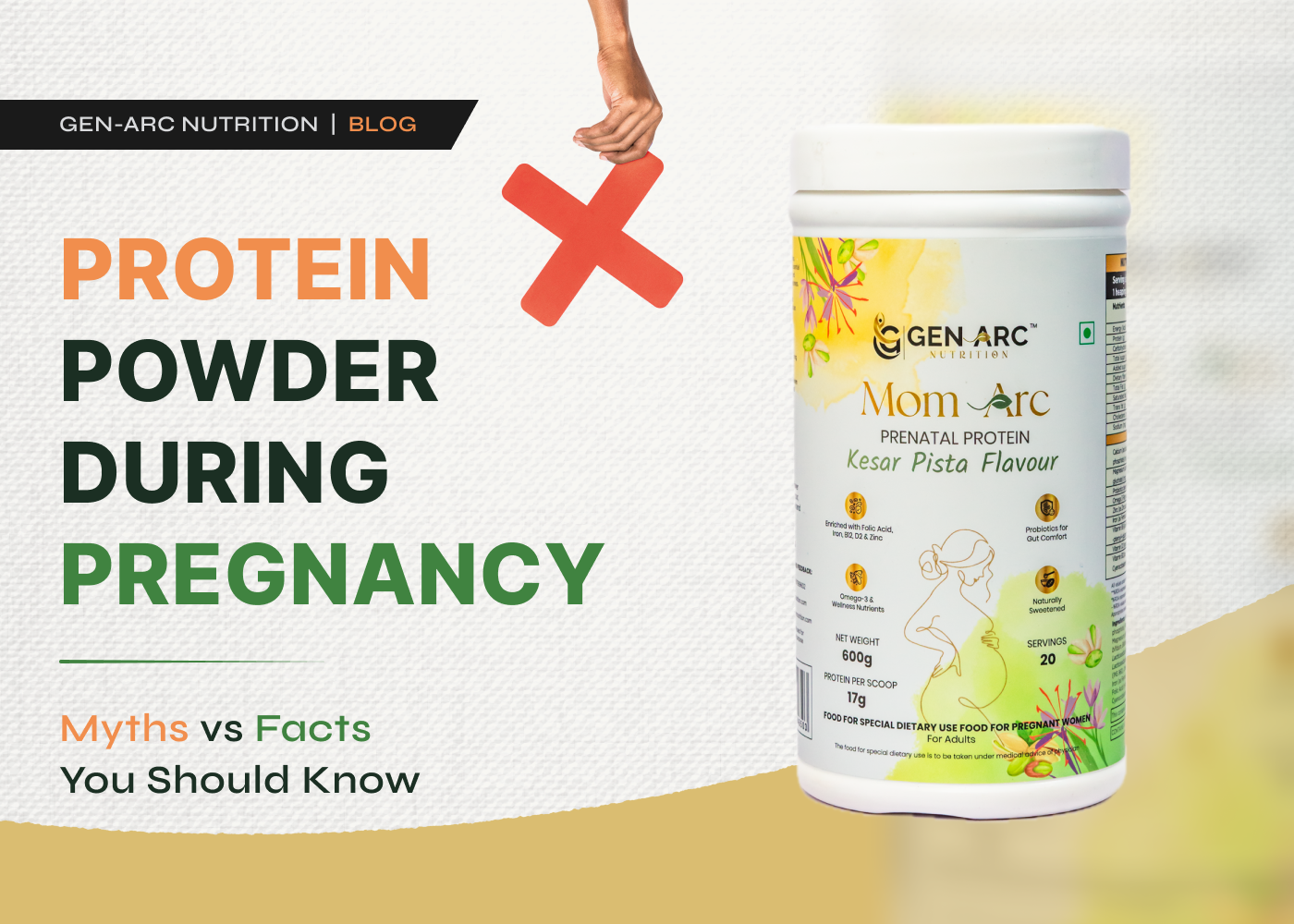
Mom ARC Prenatal Protein Blend by Gen Arc Nutrition is built specifically for this.
With 17.03g of high-quality protein per scoop, this is nutritional support built for motherhood. It delivers 335.5mcg of Folic Acid, 50mg Omega-3, Iron, Vitamin B12, Calcium, and Magnesium to support you and your baby. Plus, 50 Billion CFUs of probiotics aid gut comfort during every trimester. All of it comes in a naturally sweetened (monkfruit) Kesar Pista formulation, designed for every stage: pre-conception, all three trimesters, and postpartum recovery.
It’s lab-tested, FSSAI and FDA certified, backed by Ayurvedic principles, and formulated to give you exactly what you and your baby need.
* Mom ARC Prenatal Protein is a nutritional supplement and is not intended to replace medical advice or prescribed prenatal care. Please consult your doctor before use.
To Conclude,
Pregnancy is not the time to second-guess every nutrition decision — it’s the time to make a few really good ones and trust them. Getting enough protein, the right micronutrients, and a supplement you can verify and trust isn’t overcautious. It’s the foundation your baby’s first months of development are built on.