By Gen Arc Nutrition | Whey Isolate · Lean Muscle · BCAA · Performance Supplements · Sports Nutrition
Walk into any gym and you’ll hear it said like settled fact: “just take whey.” And for most people, that’s where the conversation ends — a scoop here, a shake there, and a quiet hope that the gains will follow.
But serious athletes — the ones chasing PRs, leaning out for competition, or simply demanding more from every training session — know that “just whey” isn’t a complete answer. The form of whey matters. The source of the raw protein matters. And what’s been added, removed, or quietly cut from the formula matters enormously.
This is a guide for people who want to understand the difference — and make the right call for their goals.
The Basics: What’s Actually Different?
Both whey protein concentrate (WPC) and whey protein isolate (WPI) come from the same origin: liquid whey, a byproduct of cheese production. The divergence is in what happens during processing.
Whey concentrate undergoes standard filtration and typically delivers 60–80% protein by weight, with the balance made up of lactose, fat, and carbohydrates. Whey isolate goes through an additional, more rigorous filtration process — cross-flow microfiltration or ion exchange — that removes most of the lactose and fat and pushes protein content to 90% and above.
On paper, isolate looks like the clear upgrade. In practice, the answer is more precise than that — and it starts with what you’re actually training for.
Why Whey Isolate Wins for Lean Muscle Gains
Lean muscle gain — not just mass, but specifically muscle with minimal fat addition — requires precision at the nutritional level. Whey isolate is structurally built for this in ways that regular whey protein simply isn’t.
Protein Purity and Content
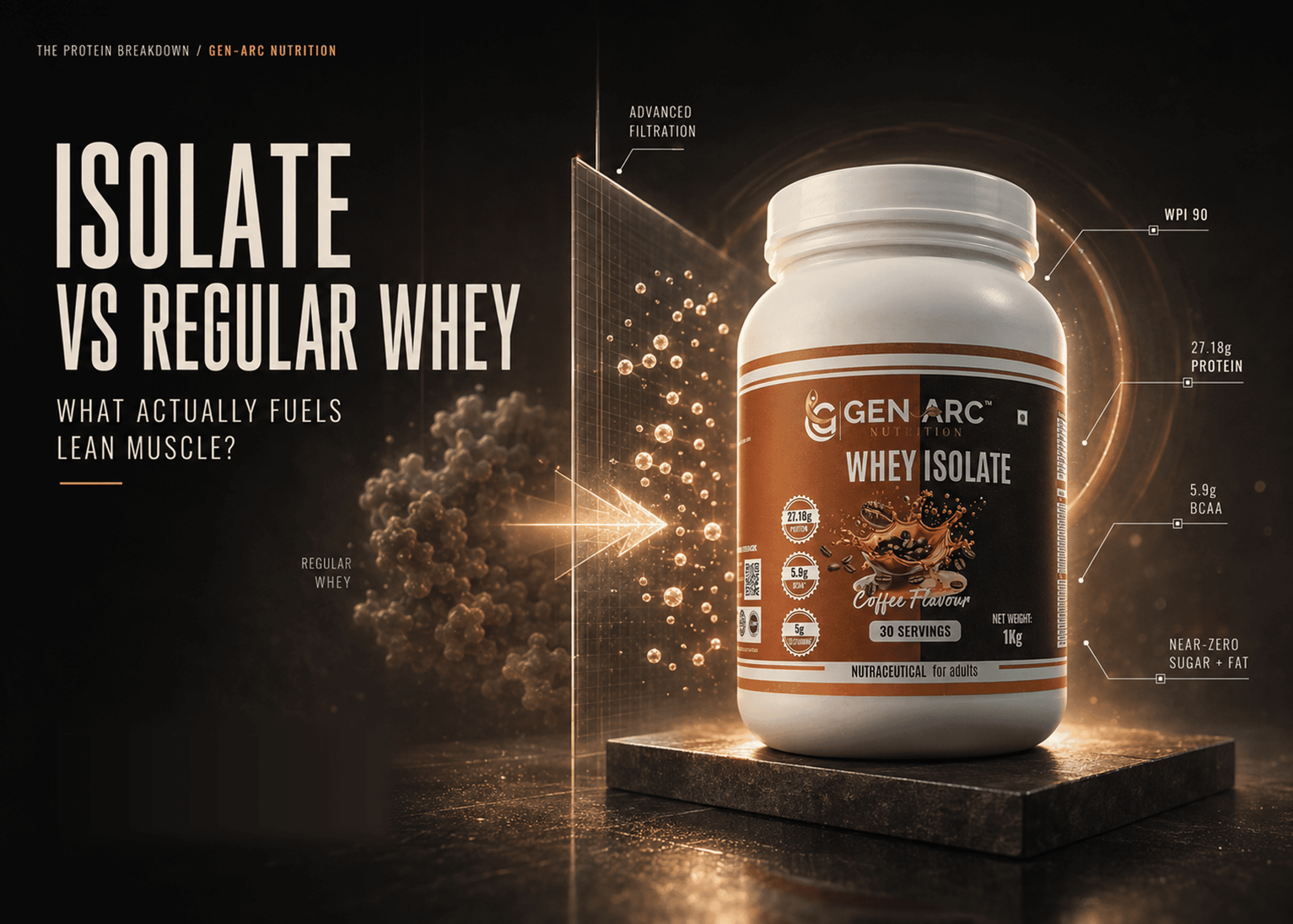
WPI 90 delivers 90%+ protein per 100g — meaning a 33g scoop provides over 27g of pure protein with just 0.2g sugar and 1.38g fat. Compare this to a standard concentrate, which at 70% protein content delivers roughly 23g protein from the same scoop size but carries significantly more lactose and fat. For an athlete counting every macro, that difference compounds across the day, the week, and the training block.
BCAAs, Leucine, and the Amino Acid Profile
Whey isolate’s high purity doesn’t just mean more protein — it means a more concentrated delivery of the amino acids that drive muscle protein synthesis (MPS).
Branched-chain amino acids (BCAAs) — leucine, isoleucine, and valine — are the primary triggers of MPS. Leucine, in particular, acts as the anabolic switch: research has established that approximately 2.5–3g of leucine per serving is required to maximally stimulate MPS.
Gen-Arc Whey Isolate (Coffee) delivers 5.9g BCAAs and 5g Glutamine per 33g serving — glutamine being critical not just for recovery but for gut health and immune function during heavy training blocks. It’s a complete essential amino acid profile, not just a protein number on a label.
Absorption Speed and Lean Gains
Whey isolate is among the fastest-digesting protein sources available — reaching peak amino acid levels in the blood within 60–90 minutes of consumption. This rapid delivery is particularly valuable in the post-workout window, when muscle tissue is primed for protein uptake and the demand for amino acids is at its highest.
With near-zero fat and carbohydrate content slowing gastric emptying, isolate clears the digestive system faster than concentrate — meaning the amino acids arrive at the muscle tissue sooner, and the recovery process begins earlier. For athletes training twice daily or competing in high-frequency sport, that window matters.
The clinical evidence is consistent on this. A 2023 randomised controlled trial found that whey isolate supplementation combined with resistance training produced significant gains in skeletal muscle mass with no corresponding fat gain. (Kim et al., 2023 — PubMed ID 36726776)
Why the Source of Raw Whey Changes Everything
Here’s the variable that almost no supplement brand talks about openly: the quality of your whey isolate is only as good as the quality of the raw whey used to make it. And raw whey quality is determined entirely by where and how it was sourced.
Gen Arc Whey Isolate is sourced from Poland — and that’s a deliberate, performance-driven decision.
Why Polish Whey Ranks Among the Best in the World
Poland consistently ranks in the top three globally for whey isolate quality. The reasons are structural, not accidental:
EU food safety standards — Polish dairy processing operates under European Union food safety and hygiene regulations, among the most rigorous in the world.
Superior amino acid profile — Polish whey isolate is known for its high leucine and BCAA density, traceable to high-quality European dairy herds.
Excellent solubility — The cold-filtration processing used for European WPI 90 preserves the native protein structure, resulting in a product that mixes cleanly and digests efficiently — not a chalky, poorly-soluble powder.
90%+ protein verified — Unlike some globally-sourced whey where label protein content and actual content diverge, European WPI 90 consistently hits or exceeds its declared protein levels under third-party testing.
For serious athletes targeting lean gains, PRs, the origin of your protein is not a minor detail. It’s the foundation everything else is built on.
The Real Comparison: Premium Protein vs Filler-Loaded Powders
The conversation about whey protein in India is often framed as isolate vs concentrate. But the more important comparison — the one with real health and performance consequences — is between premium, clean-formula protein and the low-end, additive-laden powders that dominate the affordable segment of the market.
Many entry-level protein powders — regardless of whether they call themselves isolate or concentrate — compensate for poor raw material quality and low actual protein content with a cocktail of additives: artificial sweeteners like acesulfame-K and sucralose in high concentrations, maltodextrin as a cheap carbohydrate filler to bulk out serving size, thickeners and gums that create a deceptive “thick” texture.
The consequences aren’t just performance-related. Excessive artificial sweetener consumption has been associated with gut microbiome disruption. Maltodextrin fillers add glycaemic load without nutritional return.
Gen Arc’s position on this is categorical: no artificial sweeteners, no fillers, no preservatives. Natural flavouring only — real coffee beans for the Coffee flavour, not a synthetic coffee extract and naturally sweetened.
Digestibility: The Absorption Advantage
Purity without absorption is wasted potential. Lactose intolerance affects a significant proportion of Indian adults — estimates range from 60–70% with some degree of sensitivity. Whey concentrate, carrying 5–8% residual lactose, triggers bloating, gas, and digestive discomfort in many users. Whey isolate, with lactose reduced to near-zero through filtration, resolves most of this by source. But optimum absorption goes further than just removing lactose.
Gen Arc Whey Isolate includes an advanced 5-enzyme digestive complex — Protease, Amylase, Lactase, Lipase, and Cellulase — designed to support full-spectrum breakdown of the protein, any residual carbohydrates, fats, and fibre in the meal or mix. Protease is the critical enzyme for athletes: it cleaves protein chains into individual amino acids and bioavailable peptides, ensuring that the protein consumed is actually converted into what muscle tissue can use.
The result: better protein utilisation per scoop, less digestive load, and a post-workout experience that doesn’t compromise the next training session.
Certifications and Batch Testing: Why Manufacturing Integrity Matters
In a market where label claims are not always matched by what’s inside the container, certifications and manufacturing standards are the only independent verification a consumer or athlete has.
For competitive athletes, the stakes are particularly high. A contaminated supplement — even from a “reputable” brand — can result in a failed drug test, a disqualification, and a career consequence that no training block can undo.
Gen Arc Whey Isolate is manufactured in a US FDA-registered facility and holds FSSAI, cGMP, HACCP, and ISO certifications — standards that govern not just what the formula contains, but how consistently and safely every batch is produced. It is WADA and NADA compliant — the gold standard for athletes in competitive sport who require verified assurance that their supplements contain no prohibited substances.
Critically: every single batch is third-party lab tested in NABL-certified laboratories for purity, safety, and consistency. Not spot-checked. Not tested at the formula stage and assumed consistent thereafter. Every batch, independently verified before it reaches the athlete.
This is what separates authentic performance supplements from performance-branded supplements. The certification tells you the standard was set. The batch testing tells you the standard was kept.
The Gen Arc Difference: Quality at Every Layer
Gen Arc Whey Isolate (Coffee) is built from the ground up for athletes who refuse to compromise — on source, on formula, on manufacturing, or on results.
WPI 90 from Poland. 27.18g protein per serving. 5.9g BCAAs. 5g Glutamine. Near-zero sugar and fat. A 5-enzyme digestive complex. Real coffee beans. Zero artificial sweeteners, fillers, or preservatives. WADA and NADA compliant. Every batch is independently tested.
What that means in practice for lean muscle gain:
More muscle protein synthesis — leucine-rich BCAA profile consistently clears the anabolic threshold per serving.
Faster recovery — rapid absorption window delivers amino acids to muscle tissue when it needs them most.
Leaner gains — 0.2g sugar, 1.38g fat per serving means protein drives the result, not empty calories.
Better digestion — near-zero lactose + 5-enzyme complex means no bloating, no discomfort, no compromised uptake.
Safe for long-term use — WADA/NADA compliance and batch-level third-party testing mean no contaminants, no banned substances, no unwanted surprises.
The Bottom Line
The question was never just isolate vs concentrate. It was always: what is the quality of the isolate, where does it come from, what’s been added to it, and how confident can you be that what’s on the label is what’s in the container?
For beginners, any clean protein is a good start. For serious athletes — for the ones tracking every gram, every recovery window, every training adaptation — the standard has to be higher.